My Pantry Was a Disaster. I Asked ChatGPT to Fix It for Under $100 — It Told Me to Stop Buying Containers.
A 24-inch cupboard, six months of chaos, and a $100 budget. ChatGPT refused to give me a Pinterest pantry — here's the 6-product system it built instead.
This post contains affiliate links. If you buy something through them, I may earn a commission — at no extra cost to you.
My pantry has been a disaster for six months.
One narrow cupboard. Five shelves. Bags of rice tipped on their sides. A cereal box balanced on top of pasta. Spice jars scattered between them like they got there by accident. Half-opened snacks that I forgot existed until I found them again, stale.
I’ve been avoiding it because every time I open Pinterest, the “solution” looks like a thousand-dollar photo shoot — matching glass jars, chalkboard labels, three tiers of decanted grains. That’s not a pantry. That’s a magazine.
So I opened ChatGPT and asked it to build me a real system. Under $100. No decorative nonsense. The first thing it said made me close Pinterest for good.
The situation
Before the prompt:
- 1-bedroom apartment, moved in 6 months ago
- Small pantry — one narrow cupboard, roughly 24” wide, 5 shelves
- Current state: bags of rice/pasta/cereal stuffed in, scattered spices, half-open snacks, zero system
- I cook simple meals: pasta, stir-fry, rice dishes, eggs
- Shop at: Amazon, Target, The Container Store, IKEA
- Budget: under $100 total
- Not a minimalist or aesthetic person — I just want to find things
I wrote the prompt the way I’d describe the problem to a friend. I told it what I cook, what I actually buy, and one instruction that changed the whole output: “Be honest — if a popular organizational product is overpriced or useless, say so.”
The reframe that mattered
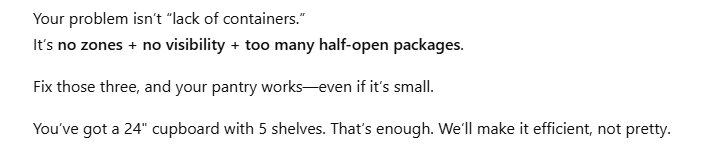
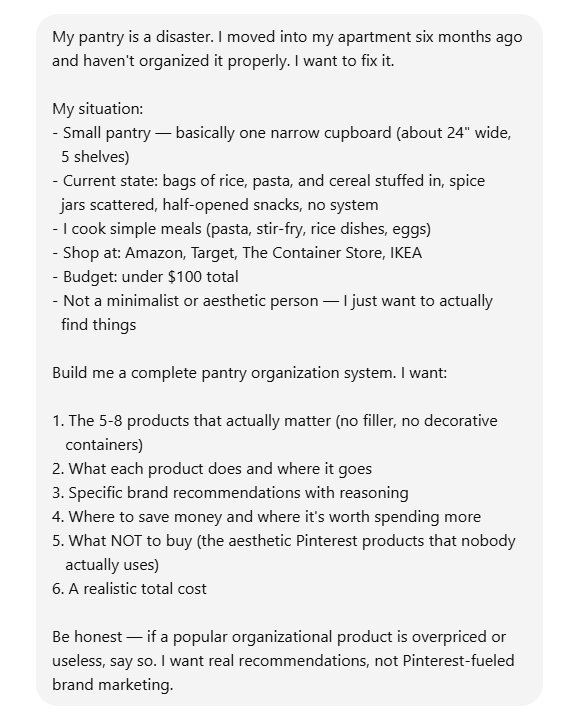
“Your problem isn’t ‘lack of containers.’ It’s no zones + no visibility + too many half-open packages.”
Read that again.
I’d spent six months assuming I needed to buy more stuff. ChatGPT told me the opposite — the stuff I had was fine, I just didn’t have a system for where things live or a way to see what I own. That’s it. That’s the whole thing.
Then it said the line that actually made me laugh: “We’ll make it efficient, not pretty.”
The system underneath the products
Before it listed a single item to buy, it gave me the structural logic. Four zones:
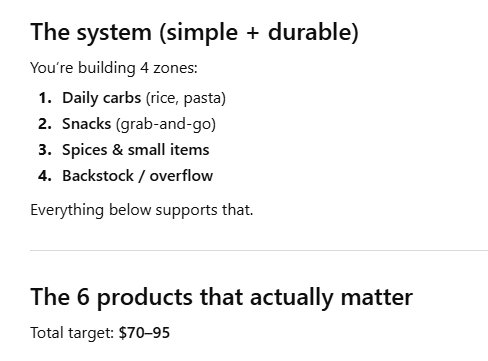
- Daily carbs (rice, pasta)
- Snacks (grab-and-go)
- Spices & small items
- Backstock / overflow
Everything below supports those four zones. If a product doesn’t serve a zone, don’t buy it. That’s the filter.
The 6 products that actually matter
Total target: $80–100. Not a dollar more.
1. Stackable clear bins — the backbone
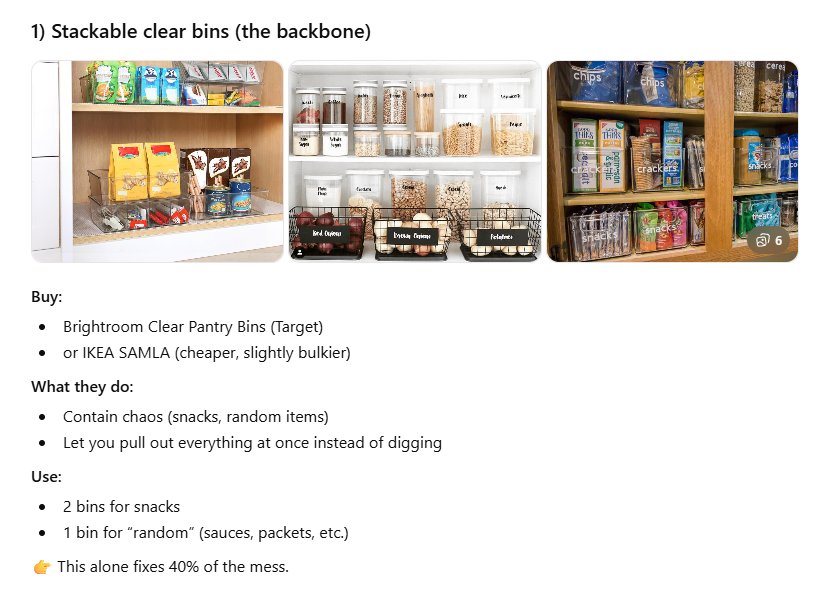
Why it matters: This is the one category that solves the most problems. Snacks and random items (sauces, packets, that lone bag of marshmallows) are where pantry chaos breeds. Bins give you a pull-out drawer in a cupboard that doesn’t have drawers.
Brands recommended:
- Brightroom Clear Pantry Bins (Target) — the default pick
- IKEA SAMLA — cheaper, slightly bulkier, works fine
Price range: $20–30 for 3 bins
ChatGPT’s exact phrasing: “This alone fixes 40% of the mess.” Buy 3 bins — two for snacks (one sweet, one savory), one for random. Don’t overthink it.
2. Airtight containers — only for high-traffic carbs
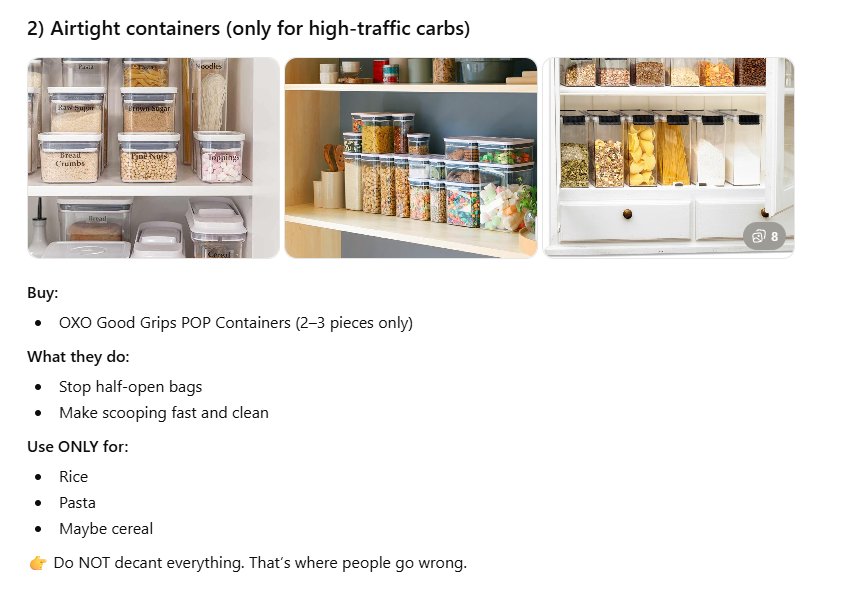
Why it matters: Half-open bags of rice and pasta are the single most common pantry failure mode. Airtight containers stop that. But — and this is the part influencers never say — you only need them for the things you cook weekly.
Brands recommended:
- OXO Good Grips POP Containers — the only brand worth the money
Price range: $25–40 for 2–3 containers
Use ONLY for: rice, pasta, maybe cereal. That’s it.
ChatGPT’s exact warning: “Do NOT decant everything. That’s where people go wrong.” The Pinterest pantry has 20 matching containers. A working pantry has 3.
3. Shelf riser — doubles your space for free
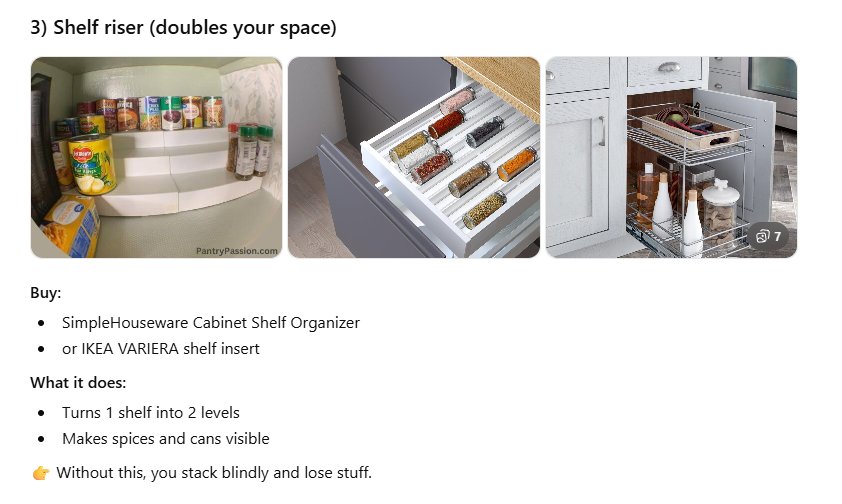
Why it matters: Turns one shelf into two levels. Suddenly your spices and cans are all visible at once instead of stacked on top of each other. You stop buying duplicates because you can actually see what you own.
Brands recommended:
- SimpleHouseware Cabinet Shelf Organizer — basic, metal, works
- IKEA VARIERA shelf insert — equally good, just a trip to IKEA
Price range: $15–25
Without this, you stack blindly and lose things. With it, the back row elevates, the front row stays visible, and you stop digging through ten jars to find cumin.
4. Lazy Susan — for sauces and oils
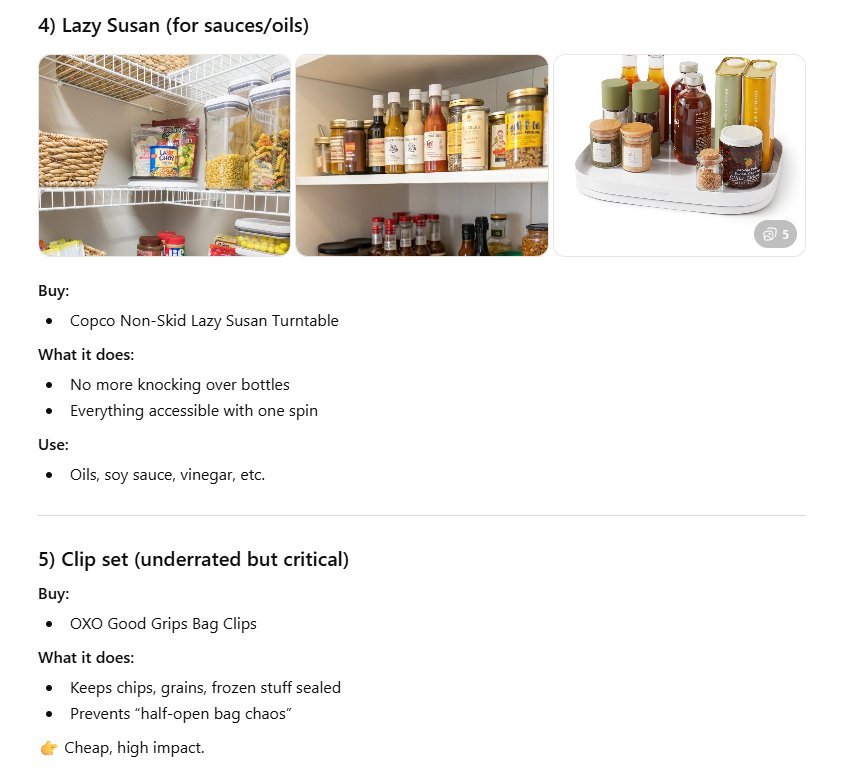
Why it matters: Bottles are the worst pantry citizens — tall, narrow, easy to tip. A Lazy Susan makes the back row as easy to grab as the front row. This is the product you didn’t know you needed until you had it.
Brands recommended:
- Copco Non-Skid Lazy Susan Turntable — the non-skid part matters
Price range: $10–15
ChatGPT was specific here: cheap Lazy Susans slide around. Spend the extra $3 on one that stays put. Use for oils, soy sauce, vinegars, honey — anything tall and tippable.
5. Bag clips — underrated and critical
Why it matters: Half-open bags are the source of 70% of pantry disappointment. Stale chips. Stale pasta. Stale everything. Bag clips are $10 and they fix it permanently.
Brands recommended:
- OXO Good Grips Bag Clips — the ones that actually seal
Price range: $10
ChatGPT called them “cheap, high impact.” That’s the entire review.
6. Labels — keep it basic
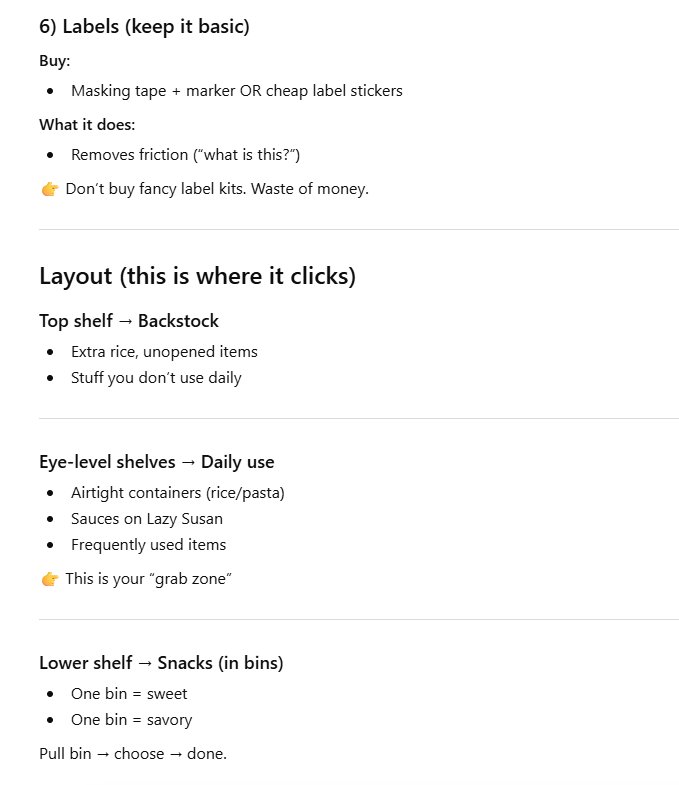
Why it matters: Labels answer “what is this?” in half a second. That’s the whole job. You don’t need chalkboard vinyl or custom printing — you need to stop opening bins to find out what’s inside.
Brands recommended:
- Masking tape + a Sharpie
- OR cheap adhesive label stickers
Price range: $5
ChatGPT’s direct take: “Don’t buy fancy label kits. Waste of money.” The only rule is that every bin and container gets one. Anything beyond that is aesthetics, not function.
The layout (this is where it clicks)
Products without a layout are just more clutter. The system only works if every zone has a home:
- Top shelf → backstock. Extra rice, unopened items, things you don’t reach for daily.
- Eye-level shelves → daily use. Airtight containers, sauces on the Lazy Susan, the stuff you actually touch.
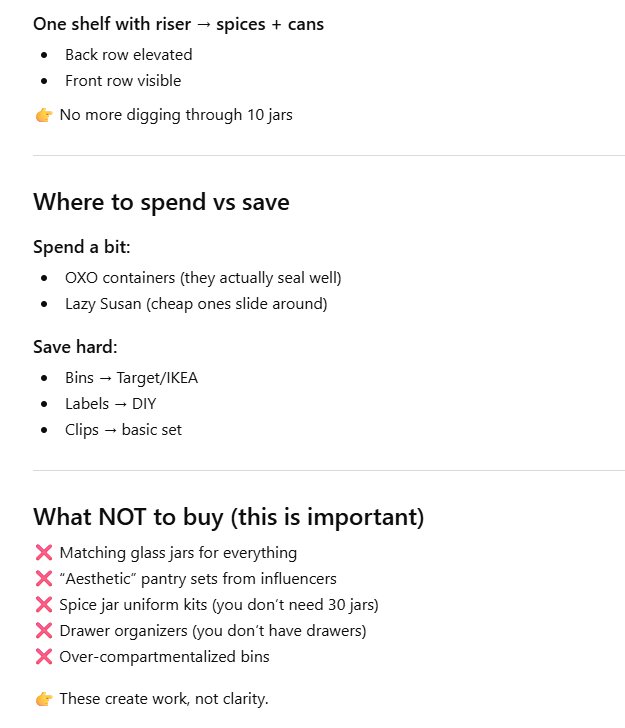
- One shelf with the riser → spices + cans. Back row elevated, front row visible.
- Lower shelf → snacks in bins. One bin sweet, one savory. Pull bin → choose → done.
That’s the whole layout. Four decisions. Never think about it again.
Where to spend vs. save
Spend a bit on:
- OXO containers — they actually seal. The cheap knockoffs don’t.
- Lazy Susan (non-skid) — the $5 ones slide around and make it worse.
Save hard on:
- Bins → Target or IKEA, not The Container Store
- Labels → DIY with tape and a marker
- Clips → basic OXO set, no premium brand needed
The rule underneath this: pay for the things that fail when they’re cheap. Everything else is just a container, and containers are commodities.
What to avoid
- ❌ Matching glass jars for everything — heavy, breakable, and a decanting tax you pay forever
- ❌ “Aesthetic” pantry sets from influencers — designed for the photo, not the cupboard
- ❌ Spice jar uniform kits (30 jars) — you own 12 spices, not 30
- ❌ Drawer organizers — you don’t have drawers
- ❌ Over-compartmentalized bins — rigid slots that fit nothing real
These create work, not clarity. The Pinterest pantry is a second job you didn’t sign up for.
The realistic total cost
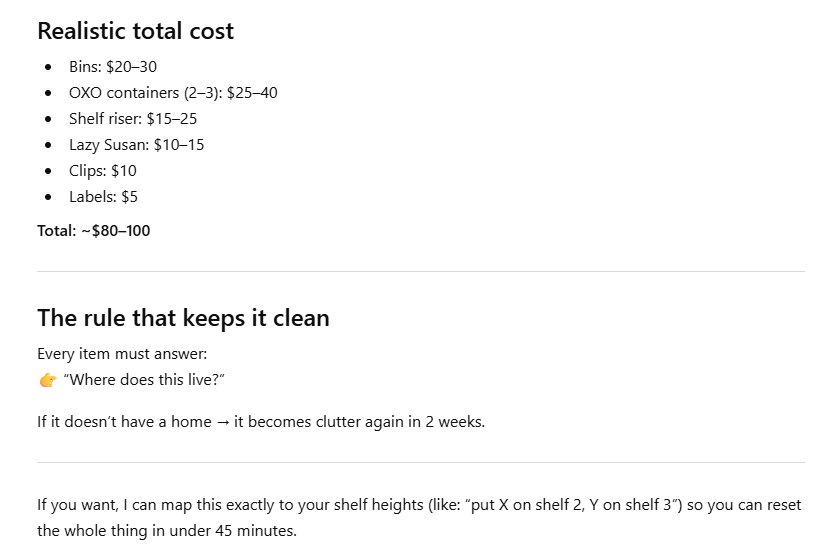
- Bins: $20–30
- OXO containers (2–3): $25–40
- Shelf riser: $15–25
- Lazy Susan: $10–15
- Clips: $10
- Labels: $5
Total: ~$80–100
That’s the whole pantry. Fixed. Under a hundred bucks.
The formula
- Define 4 zones (daily carbs, snacks, spices, backstock)
- Buy 6 products — no more, no less
- Assign every item a home — if it doesn’t have one, it becomes clutter again in two weeks
- Pay for sealing and non-slip — save on everything else
- Ignore anything Pinterest sells
That’s it. That’s the whole article in five lines.
5 things I learned from this conversation
1. The problem is never “more containers.”
I thought I needed to buy my way out of chaos. The actual problem was structural — no zones, no visibility, no system. Containers without zones just give you neater chaos.
2. Decanting everything is a trap.
Every Pinterest pantry decants rice, pasta, flour, sugar, cereal, nuts, coffee, and twelve other things into matching jars. It looks beautiful. It also means refilling eight containers a week forever. Decant three things max — the stuff you actually cook with weekly.
3. Visibility beats aesthetics.
A shelf riser costs $15 and is the single highest-impact product. Not because it looks good — because you can suddenly see everything you own. That ends duplicate-buying, forgotten-spice syndrome, and 80% of the “I thought I had that” moments.
4. The expensive brands aren’t always the cheap answer.
OXO is worth the spend because cheap airtight containers don’t actually seal — they just look like they do. Lazy Susans are worth spending on because non-skid actually matters. But bins? Clips? Labels? Target, IKEA, and a marker. Buying “premium” versions of commodity items is the fastest way to blow a $100 budget.
5. Influencer pantries are a different category than real pantries.
A real pantry is a tool. An influencer pantry is a set. You’re not building a Nancy Meyers kitchen — you’re building a cupboard that lets you cook dinner without excavating. Those are two completely different projects. Stop buying the set.
The prompt you can steal
If you want ChatGPT to give you a real pantry plan (not a Pinterest one), use this:
My pantry is a disaster. I want to fix it — but I want a real
system, not an aesthetic one.

My situation:
- [Pantry size and shelf count]
- [Current state — be honest, it's fine]
- I cook: [the 5–10 meals you actually make]
- Shop at: [your retailers]
- Budget: $[amount] total
- [One line on what you DON'T want — "not a minimalist,"
   "not into aesthetics," etc.]

Build me a complete pantry organization system. I want:

1. The 5–8 products that actually matter (no filler, no
   decorative containers)
2. What each product does and where it goes
3. Specific brand recommendations with reasoning
4. Where to save money and where it's worth spending more
5. What NOT to buy (the aesthetic Pinterest products that
   nobody actually uses)
6. A realistic total cost

Be honest — if a popular organizational product is overpriced
or useless, say so. I want real recommendations, not Pinterest-
fueled brand marketing.
The two lines that matter:
“I cook [specific meals]” — this pivots the output from “pantry products” to “pantry products that serve the way you actually eat.” You don’t need a flour container if you don’t bake.
“Be honest — I want real recommendations, not Pinterest-fueled brand marketing” — explicit permission to trash the aesthetic-industrial complex. Without this line, ChatGPT will default to Instagram-safe answers.
Frequently asked questions
Do I really only need 6 products?
Yes. Six products, four zones, one layout. Anything beyond that is decoration — and decoration in a cupboard is a tax, not a feature. If you’re tempted to add a seventh product, ask: which zone does it serve? If the answer isn’t immediate, skip it.
Is OXO actually worth the money?
For the 2–3 airtight containers you’ll use daily, yes. The cheap knockoffs don’t seal properly, which means stale pasta, stale rice, and the exact problem you bought the container to solve. For every other category — bins, clips, labels — the cheap version works fine. OXO is specifically worth it for sealing.
What about glass jars for spices?
Skip them. You probably own 10–15 spices, not 30. A uniform spice kit forces you to either leave half the jars empty (which looks worse than the original mess) or buy spices you’ll never use. A shelf riser and the jars your spices already come in is the answer.
Do I need The Container Store for any of this?
No. Target, IKEA, and Amazon cover the entire list. The Container Store’s pricing on basic bins is 2–3x what Target charges for the same function. The only reason to go there is if you want a specific aesthetic — which, per the prompt, we’re not doing.
What if my pantry is bigger than 24 inches?
The system scales. Same 4 zones, same 6 product categories — just buy more bins and maybe a second Lazy Susan. What doesn’t scale is decanting more things or adding more container types. More space is not permission to add complexity.
Get the prompt library
I'm building a library of the exact ChatGPT prompts I use for real decisions — pantry, cookware, paint, scent. Send me your email and I'll send them when they're ready.
Send me the promptsHave a situation of your own?
This site runs on real conversations. If you have a room or a system you’re stuck on — a pantry, a closet, a garage, a category you don’t know how to research — I’d love to run it through AI and document what comes back.
Email me: contact@lifemeetsai.com
— Carl