I Asked ChatGPT How to Make My Apartment Smell Like a Luxury Hotel. It Said I've Been Doing It Wrong.
ChatGPT built me a 6-piece hotel scent system for under $250. Honest brand takes on Diptyque, Nest, and Boy Smells included.
This post contains affiliate links. If you buy something through them, I may earn a commission — at no extra cost to you.
I stayed in a hotel last month.
Nothing crazy — a boutique place, a Friday night. But the moment I walked into the lobby, I noticed the smell. Not in the “there’s a strong scent” way. In the “this place feels expensive and I can’t quite tell why” way. It followed me to my room. Clean, warm, slightly woody. Quietly everywhere.
I came home and my apartment smelled… fine. Not bad. Not good. Just neutral — the absence of scent, which I now realize is its own kind of poverty.
I had a $70 candle. I lit it. The room smelled like that candle. Exactly like that candle. Loud, one-note, obvious. The opposite of what I was chasing.
So I opened ChatGPT and asked it to build me a real hotel-scent system. Like the cookware conversation before it, this one started with me expecting a list and getting something better.
The situation
Before the prompt:
- 1-bedroom apartment, mid-size
- Not allergic to anything, not sensitive to scents
- Shops at Amazon, Williams-Sonoma, Target, Sephora, direct brand sites
- Budget: $150–250 to start
- Goal: a layered scent system — not one overpowering candle
I wrote the prompt honestly — including the brands I was considering (DS & Durga, Nest, Diptyque) and the explicit ask for brand honesty, not brand loyalty.
The reframe that mattered
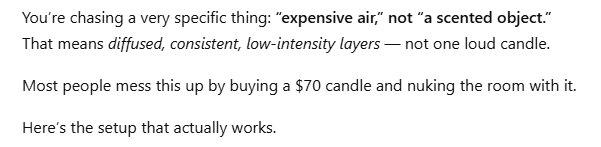
“You’re chasing a very specific thing: expensive air, not a scented object.”
This is the sentence I keep coming back to.
Most people’s approach to home fragrance — and I was one of them — is to buy one strong candle, light it, and hope. That’s why you walk into someone’s house and immediately know “ah, they burned a candle.” You’re supposed to smell the place, not the product.
ChatGPT’s framing: diffused, consistent, low-intensity layers. Multiple quiet sources instead of one loud one. That’s what hotels actually do. And it’s the opposite of what most of us buy.
The 6-piece hotel scent system
Total budget came in at $180–240, depending on brand choices.
1. Living room anchor — the reed diffuser (the backbone)
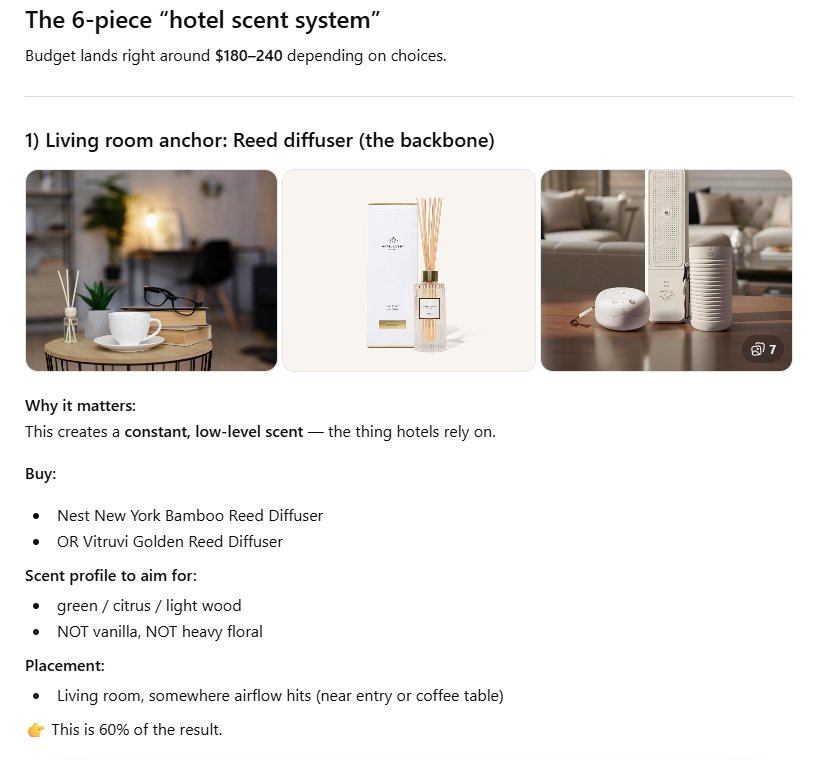
Why it matters: This is the only item that runs 24/7. It’s the base layer. Everything else is optional on top.
Brands recommended:
- Nest New York Wild Mint & Eucalyptus Reed Diffuser
- OR Vitruvi Golden Reed Diffuser (cleaner aesthetic, slightly less throw)
Scent profile to aim for: green / citrus / light wood. NOT vanilla, NOT heavy floral.
Placement: Living room, wherever airflow hits — near the entry or on a coffee table. So the scent moves with the air, not just from one spot.
The insight that changed my thinking: this single item is 60% of the result. If you only buy one thing, buy this.
2. Bedroom — the soft candle (warm layer)
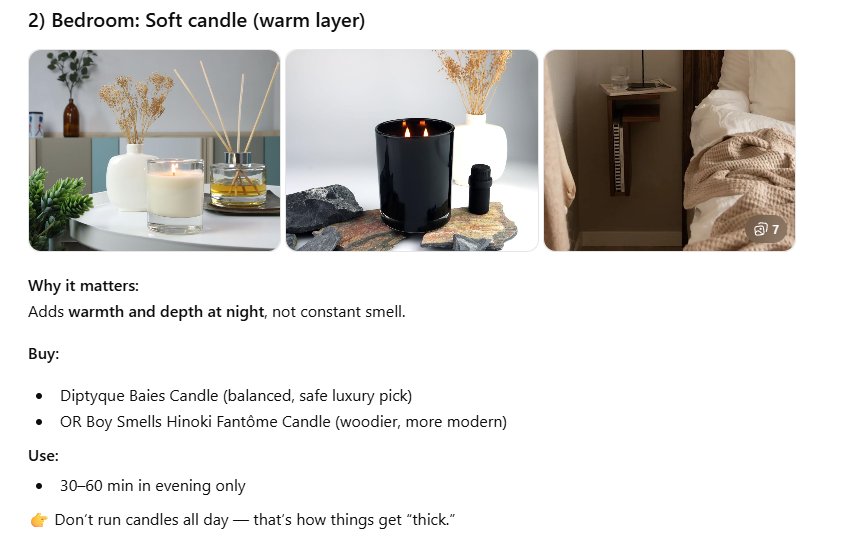
Why it matters: Adds warmth and depth at night. Not a constant scent — an evening ritual.
Brands recommended:
- Diptyque Baies Candle (the balanced, safe luxury pick)
- OR Boy Smells Hinoki Fantôme Candle (woodier, more modern)
Use: 30–60 minutes in the evening only.
The warning: “Don’t run candles all day — that’s how things get thick.” A candle lit for five hours is why rooms start to feel stuffy and cloying. Thirty minutes is the hotel trick.
3. Bathroom — the clean reset spray
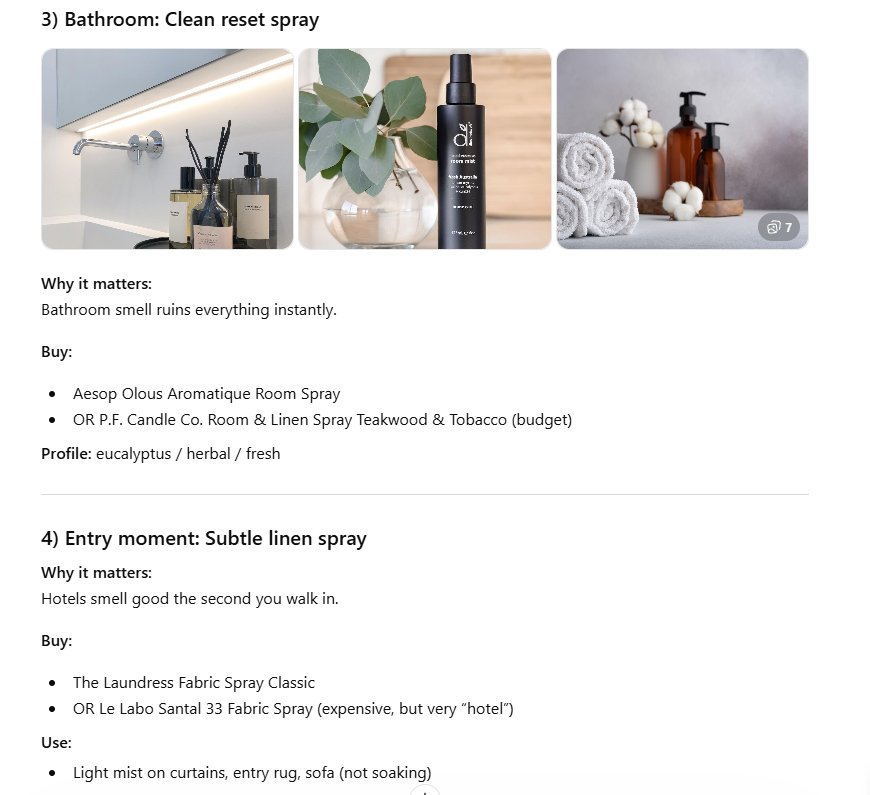
Why it matters: Bathroom smell ruins everything instantly. You can have the most beautifully scented living room in the world — it dies the moment someone walks past an untreated bathroom.
Brands recommended:
- Aesop Olous Aromatique Room Spray (premium pick)
- OR P.F. Candle Co. Room & Linen Spray in Teakwood & Tobacco (budget pick)
Profile: eucalyptus / herbal / fresh.
4. Entry moment — the subtle linen spray
Why it matters: Hotels smell good the second you walk in. That first impression is a deliberate design choice — not a coincidence.
Brands recommended:
- The Laundress Fabric Spray Classic (more affordable)
- OR Le Labo Santal 33 Fabric Spray (expensive, but very “hotel”)
Use: Light mist on curtains, entry rug, sofa. Not soaking — a passing suggestion of scent.
5. Hidden weapon — vent / airflow scenting
Why it matters (most people miss this): Hotels scent the air system, not just surfaces. The smell moves because the air moves.
What to buy: Scent sachets or diffuser oil pads (Amazon is fine — this is where you don’t need premium).
Hack: Place them near:
- Entry airflow
- Fan
- AC / heat vents
The result: scent travels naturally instead of sitting in one spot. This is the single move that separates an amateur setup from an actual hotel feel.
6. Kitchen odor control (critical)
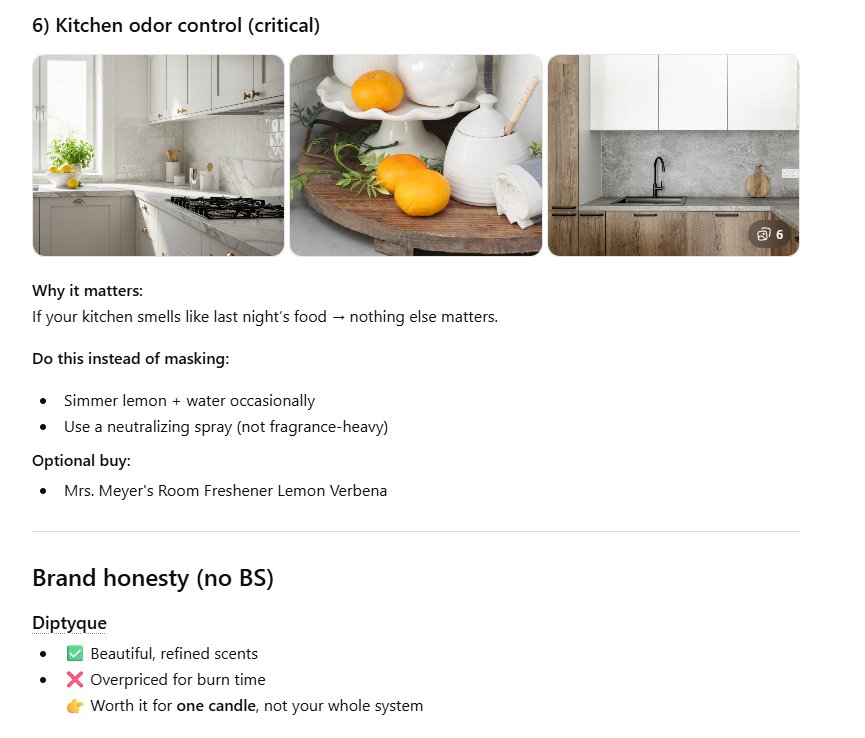
Why it matters: If your kitchen smells like last night’s food, nothing else matters. The rest of the system is wasted.
Do this instead of masking:
- Simmer lemon + water occasionally
- Use a neutralizing spray (not fragrance-heavy)
Optional buy: Mrs. Meyer’s Room Freshener in Lemon Verbena.
Most people layer strong fragrances on top of cooking smells. Hotels neutralize first, then layer on clean air. It’s the difference between covering up a problem and removing it.
Brand honesty (no BS)
This was the section I was most curious about. I’d nearly ordered a full Diptyque setup for $400. Here’s ChatGPT’s actual assessment of the premium fragrance brands:
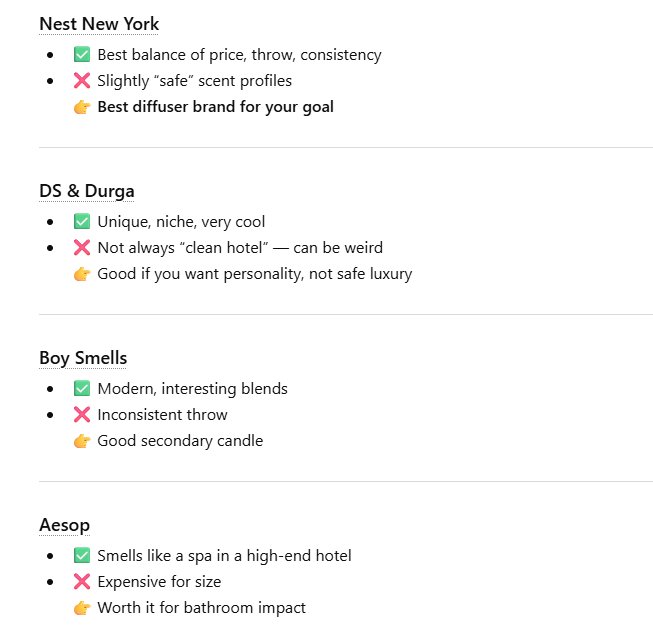
Diptyque
- ✅ Beautiful, refined scents
- ❌ Overpriced for burn time
- → Worth it for one candle, not your whole system
Nest New York
- ✅ Best balance of price, throw, consistency
- ❌ Slightly “safe” scent profiles
- → Best diffuser brand for this goal
DS & Durga
- ✅ Unique, niche, very cool
- ❌ Not always “clean hotel” — can be weird
- → Good if you want personality, not safe luxury
Boy Smells
- ✅ Modern, interesting blends
- ❌ Inconsistent throw
- → Good secondary candle
Aesop
- ✅ Smells like a spa in a high-end hotel
- ❌ Expensive for size
- → Worth it for bathroom impact only
This saved me about $250. I was about to anchor the entire system on Diptyque candles — exactly the wrong move.
What to avoid (this is where people ruin it)
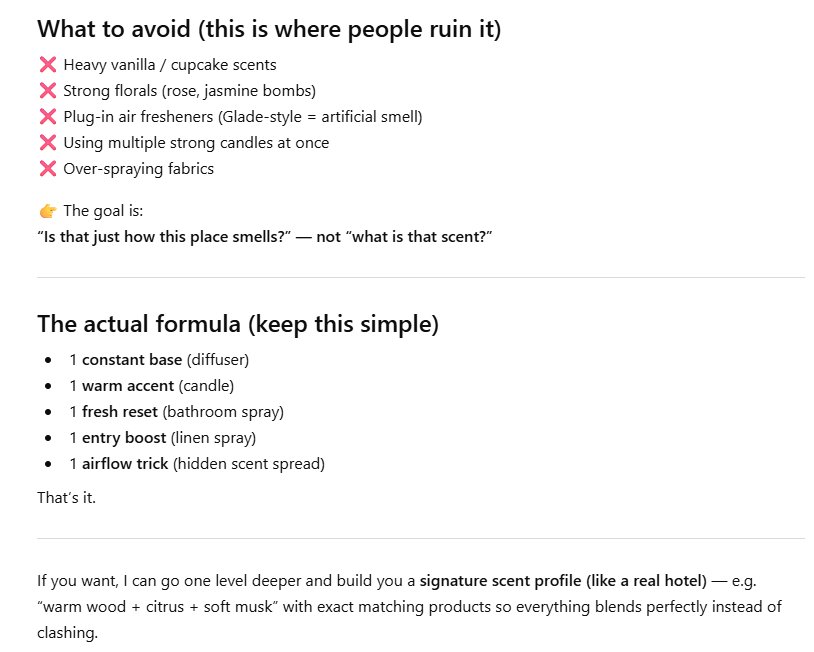
The skip list:
- ❌ Heavy vanilla / cupcake scents — reads as “air freshener,” not “luxury”
- ❌ Strong florals (rose, jasmine bombs) — overwhelming fast
- ❌ Plug-in air fresheners — Glade-style = artificial, instantly cheap
- ❌ Using multiple strong candles at once — the single most common mistake
- ❌ Over-spraying fabrics — suffocates the space instead of enhancing it
The goal is: “Is that just how this place smells?” — NOT “what is that scent?”
If someone walks in and asks what candle you’re burning, you’ve failed. If they walk in and slightly exhale, you’ve nailed it.
The actual formula (keep this simple)
Reduced to its essence, the whole system is:
- Constant base (diffuser)
- Warm accent (candle)
- Fresh reset (bathroom spray)
- Entry boost (linen spray)
- Airflow trick (hidden scent spread)
That’s it. Five roles, filled by five products. The sixth (kitchen odor control) is a corrective, not a layer.
5 things I learned from this conversation
1. The project isn’t “products.” It’s “air.”
I’d been shopping for better candles. ChatGPT told me I should have been designing the space’s atmosphere. That’s a fundamentally different project — and a cheaper one, usually.
2. One loud candle is the amateur move.
Every home fragrance mistake I’ve made traces back to this. Buy one strong candle, light it, expect magic. Hotels never do that. They use diffusers running 24/7 and candles for accents.
3. “What not to buy” saves the most money.
Heavy florals, vanilla bombs, plug-ins, multiple candles at once — I’d done all of these at some point. The skip list was worth more than the buy list.
4. The hidden-weapon move (vents + sachets) is free-tier magic.
Nobody thinks to scent the air system itself. Scent sachets near vents cost $10. They move more fragrance through the apartment than a $70 candle sitting in one spot. If you’re setting up a new space from scratch, this pairs well with the first-apartment shopping list — get the basics right, then layer scent on top.
5. Bathroom and kitchen beat living room for impact.
You can spend $200 making the living room smell perfect. If the bathroom smells off or the kitchen smells like last night’s fish, none of that matters. Fix the bad smells first. Then add the good ones.
The prompt you can steal
If you want to build your own fragrance system, here’s the template:
I want to make my home smell like [specific vibe — luxury hotel,
spa, Scandinavian cabin, high-end coffee shop, etc.].

My situation:
- [Apartment/house size, layout]
- [Any allergies or sensitivities]
- Shop at: [your preferred retailers + any premium brands you're
  open to]
- Budget: $X to start
- [One sentence on what you DON'T want it to smell like]

Build me a complete home fragrance setup. I want:

1. The 5–7 products that actually matter (no filler)
2. Which rooms each product goes in and why
3. Specific brand recommendations with reasoning
4. What to avoid (be specific about scent profiles)
5. The honest take on famous brands (Nest, Diptyque, DS & Durga,
   Boy Smells, etc.) — which are worth it, which are overpriced

Be honest — if something like Diptyque is overpriced for what it
delivers, say so. If there's a cheaper alternative that works just
as well, mention it. I want real recommendations, not brand loyalty.
The two details that matter:
“I don’t want one overpowering candle — I want a layered scent system” — this single sentence pivots the output from “best candles” to “how hotels actually do it.” Massive change in quality.
“Be honest — if X is overpriced, say so” — gives ChatGPT explicit permission to push back on premium brands. Without this, it tends to hedge.
You can find more prompts like this in the prompt library.
Frequently asked questions
Is a reed diffuser really more important than a candle?
Yes. A candle produces intense scent for the hour it’s lit, then nothing. A reed diffuser produces low-level scent continuously for months. For a space-wide hotel feel, you want constant presence, not spikes. This is why hotels rely on diffusers in their air systems — not candles.
Is Diptyque overpriced?
For the whole system, yes. A $70 Diptyque candle burns for 50–60 hours. A $30 Nest candle produces comparable throw with similar burn time. Where Diptyque earns its price is in refinement — so buy one as your “accent” candle in the bedroom. Don’t build the system around it.
What scent profile is “hotel”?
Green, citrus, light wood, subtle musk. Think grapefruit, bergamot, bamboo, tea leaf, sandalwood — clean and warm, not sweet and not floral. The phrase ChatGPT used: “expensive air.” Avoid vanilla, avoid heavy florals, avoid anything labeled “cozy cabin” or “fall spice.”
How do I layer scents without them clashing?
Pick related scent families. If your diffuser is citrus-green, your candle should be wood-musk or light spice — not vanilla cupcake. A rough rule: diffuser is the base note, candle is the warm accent, sprays are the fresh touches. Same “family” of scents across all three.
What’s the single best thing to buy first if I can only afford one item?
The reed diffuser. ChatGPT explicitly said this represents 60% of the result. One Nest or Vitruvi diffuser in the living room, placed near airflow, will do more for your home’s scent than any single candle you could buy.
Get the prompt library
Four more prompts I've used for home, kitchen, and everyday decisions — plus the fragrance template above. One email, no spam.
Send me the promptsHave a situation of your own?
This site runs on real conversations. If you have a home project you’re stuck on — a room that feels off, a system you can’t build yourself, a category you don’t know how to research — I’d love to run it through AI and document what comes back.
Email me: contact@lifemeetsai.com
— Carl